
Deputy Vice-Chancellor for Academic Affairs
16 August, 2021 2021-08-16 8:47Deputy Vice-Chancellor for Academic Affairs
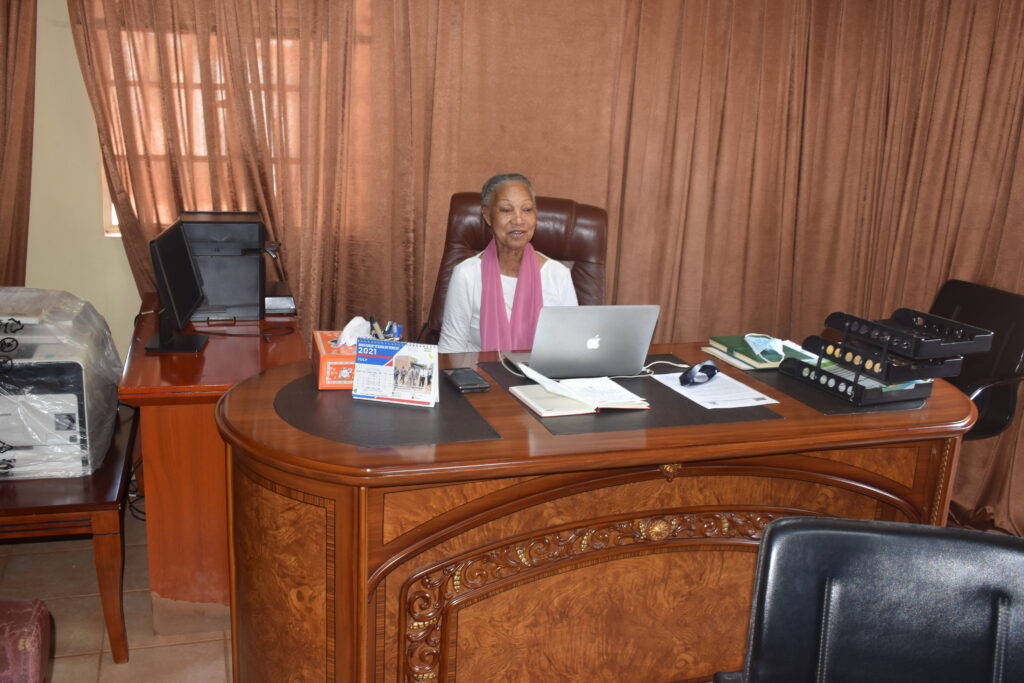
Prof. Pauline Elaine Riak
Deputy Vice-Chancellor for Academic Affairs
Professor Riak, a graduate of Stanford University (USA), is the first of only two female full professors at the university level in South Sudan. She brings strong leadership and management expertise to all of her work endeavors. The founder of the Sudanese Women’s Association in Nairobi (SWAN), Professor Riak mentored the growth and empowerment of over 800 women in exile. In the first government after independence, more than 75% of the prominent political and military women leaders in independent South Sudan were active members of SWAN. She is the co-founder of the South Sudanese Women’s Coalition for Peace and Development (SSWCPD).
The former Chairperson of the South Sudan Anti-corruption Commission (with national ministerial portfolio) for six years, Professor Riak understands the nuances of working politically at all levels of government. Her work experience encompasses a wide range of fields from academia to the private and public sectors. Professor Riak understands how to build institutions to be both functional and resilient. As a Professor of Sociology at Kenyatta University in Kenya, she established and led the Sociology Department for four years.
Her approach involves a unique, collaborative style that focuses on sound research and analysis, bringing key stakeholders to the table, maximizing collective strengths and building consensus. Professor Riak is passionate about education of women and girls, peace building and reconciliation and firmly believes in the capacity and ability of Africans to work together to build strong resilient cultures of peace.
Over the past twenty plus years, she has built up significant work experience in the Great Lakes region. She is currently the Chairperson of the Board of Directors of the Sudd Institute, a leading think thank research organization in South Sudan, the Deputy Vice Chancellor for Academic Affairs and Research at the Rumbek University of Science and Technology, South Sudan, a signatory to the current Revitalized Peace Agreement to the Conflict in South Sudan (R-ARCSS) and a member of the Joint Monitoring and Evaluation Commission (JMEC), that oversees the work of the mechanisms for the implementation of the R-ARCSS.
Professor Riak is also a trained and experienced mediator in gendered and inclusive techniques for sustainable peace building. She nurtured the establishment and development of the National Transformational Leadership Institute (NTLI) at the University of Juba (UJ). In the past two years the institute has trained over 3000 women leaders across the nation on Transformational leadership, Peace building and reconciliation, Economic empowerment and the Prevention of gender based violence.
Her approach involves a unique, collaborative style that focuses on sound research and analysis, bringing key stakeholders to the table, maximizing collective strengths and building consensus. Professor Riak is passionate about education of women and girls, peace building and reconciliation and firmly believes in the capacity and ability of Africans to work together to build strong resilient cultures of peace.
Over the past twenty plus years, she has built up significant work experience in the Great Lakes region. She is currently the Chairperson of the Board of Directors of the Sudd Institute, a leading think thank research organization in South Sudan, the Deputy Vice Chancellor for Academic Affairs and Research at the Rumbek University of Science and Technology, South Sudan, a signatory to the current Revitalized Peace Agreement to the Conflict in South Sudan (R-ARCSS) and a member of the Joint Monitoring and Evaluation Commission (JMEC), that oversees the work of the mechanisms for the implementation of the R-ARCSS.
Professor Riak is also a trained and experienced mediator in gendered and inclusive techniques for sustainable peace building. She nurtured the establishment and development of the National Transformational Leadership Institute (NTLI) at the University of Juba (UJ). In the past two years the institute has trained over 3000 women leaders across the nation on Transformational leadership, Peace building and reconciliation, Economic empowerment and the Prevention of gender based violence.
Academic Profile
1983 - PhD International Development Education, Stanford University, California, USA
1978 - MA in Sociology, Stanford University, California, USA
1978 - MA in Education, Stanford University, California, USA
1970 - BA in Education, Bluffton College, Ohio, USA
Work Experience
2019 - present: Appointed member of the UN Secretary General’s High Level Panel on Internal Displacement, Geneva, Switzerland.
2019 - present: Deputy Vice Chancellor for Academic Affairs, Rumbek University of Science and Technology, Rumbek, South Sudan, Responsible for all administrative issues relating to students and academic faculty.
2013 – 2019: Deputy Vice Chancellor for Academic Affairs, University of Juba, South Sudan.
Responsible for all academic administrative issues relating to over 500 academic faculty members and just over 11,000 students.
2013 – present: Chairperson, Board of Directors, The Sudd Institute, Juba, South Sudan
The Sudd Institute is an independent research organization that conducts and facilitates research and training to inform public policy and practice, to create opportunities for discussion and debate, and to improve analytical capacity in South Sudan. The institute’s intention is to significantly improve the quality, impact and accountability of local, national and international policy and decision-making in South Sudan in order to promote a more peaceful, just and prosperous society.
2012 – 2013: Executive Director, The Sudd Institute, Juba, South Sudan
Oversees the day to day operations of a research and training institution that is premised on the belief that public policy must be informed by reliable data, objective analysis and thoughtful debate. As South Sudan embarks on critical state and nation building and development initiatives, little is known and understood about the country and the needs of its institutions and peoples. The institute was established to close this gap and help ensure that decisions made during this critical period in the country’s history result in positive change.
2012 – 2014: Professor of Sociology and Director, Institutional Development, Research and Alumni Affairs, University of Bahr el Ghazal, Wau, South Sudan.
With the support of the University Senate, through participatory processes, and with a wide range of stakeholder groups (including government and non-state actors), developed the Master Plan for the expansion of the University of Bahr el Ghazal.
2006 – 2011: Chairperson, South Sudan Anti-Corruption Commission (SSACC), with Nation Ministerial Portfolio, Juba, South Sudan.
SSACC supported staff and institutions in their potential to become sustainable state and county institutions fostering democratic reforms and putting in place checks and balances for inclusive social, economic and cultural rights. Anti-corruption officers formed an institutionalized link between citizens and policy makers around an agenda of development issues, crucial for democratic governance in South Sudan.
1993 – 1997: Founder and Head of the Department of Sociology, Kenyatta University, Nairobi, Kenya
Established the Department of Sociology at Kenyatta University in Kenya. Supported its organizational sustainability and resilience. Served as its academic and administrative head. Ensured that curriculum was developed, faculty recruited, classes taught, monitored and evaluated. Member of the University Senate and head of the Committee on Student Affairs.
1997 – 1999: Advisor to the Government of Tanzania Kagera Region, Tanzania
Provided technical expertise in developing strategic relationships between international humanitarian organizations, Tanzania government officials, local Tanzanian communities and Rwandan refugee communities during the genocide and the immediate months that followed. Created alignment between local government priorities and national plans. Defined how each community would work within the Tanzania government’s legal framework, taking into account the needs of local communities and refugees. Facilitated discussions and brokered agreements between the various stakeholders (donors, Tanzanian civil servants, local Tanzanians and Rwandan refugees). Developed a strategic plan that defined roles, responsibilities and engagement of all stakeholders.
1993 – 2005: Co-founder, Elected Chairperson and CEO, Sudanese Women’s Association in Nairobi (SWAN), Nairobi, Kenya
Established an organization that nurtured human and professional development of many current women political leaders in South Sudan who at the time were in exile in the region. Mentored and supported the educational, socio-economic and political development of over 800 South Sudanese women and over 3,000 children in Kenya, Uganda and Tanzania. Resourced psychological counseling, skill development, formal and informal education, and small business loans. Encouraged a resilient culture among the South Sudanese refugee community.
1993 – 2005: Senior Development Consultant:
Acted as senior development consultant to:
• The World Bank/Government of Kenya.
• Governments of Tanzania and Uganda.
• Several international organizations: Action Aid, ATMS International, CARE, Caritas, DHV, Mennonite Central Committee, Pan-African Foundation, Trocaire, UNDP, UNESCO, and World Vision International
Research Interest
- Building sustainable partnerships and organizations
- Sociological research, baseline and final project evaluations
- Democracy and governance training and capacity building
- Organizational development and strategic planning
- Coordination and collaboration partnering
Publications
- Mainstreaming Women in Development Initiatives in the Sudan during the Interim Period, 2006. IGAD/UNIFEM, Nairobi, Kenya.
- Engaging in Post War Sudan: Pre-Assessment Study for Action Aid International Re-entry into Sudan, 2006. AAI, Nairobi Kenya.
- Impact of a Decade of Peace Training in the Countries of the Great Lakes Region of Africa, 2005. Quaker Service, Norway.
- An Evaluation of the Work of St. Patrick’s Missionaries in South Sudan (Lotimore) 2003. Torit Diocese, Eastern Equatorial State, South Sudan.
- Alternative Education Strategies for Ugandan Primary School Enrollment, 2002, UNDP/MOE, Kampala, Uganda.
- Envisioning the Mennonite Churches in Africa in the Next Decade, 2002. Mennonite Central Committee, Pennsylvania, USA and Winnipeg, Canada.
- Access to Higher Education, Performance, Equity and Gender Issues in Kenya, 1996, World Bank/ Government of Kenya.
- Kagera Region Action Plan for Socio-Economic Development, 1997–1998, Prime Minister’s Office, Dares-Salaam, Tanzania.
- Lakes State Action Plan for Socio-economic Development, 1999, Panacar, Yirol, South Sudan.
- A Gender Assessment Study of Micro-enterprise Development in Nyanza Province, 1995. Care International, Nairobi, Kenya.
- Mid-term Evaluation: Morulum Drought Intervention and Development Project, 1993. USAID/World Vision International Nairobi, Kenya.
- Management Training for Rural Development: End of Project Evaluation, 1992. Care International/Pan-Afcon/DHV, Nairobi, Kenya.
- Prioritizing Research Issues and Soliciting Funds for Capacity Building, 1992. Kenyatta University, Nairobi, Kenya.
- AIDS in Paradise: Bukoba Baseline Survey, 1991. World Vision International, Arusha, Tanzania. Child Survival Project: Kahama Baseline Survey, 1990. World Vision International, Arusha, Tanzania.
- Baseline Survey, Ogbomosho South, Nigeria, 1989. ATMS International, Nairobi, Kenya.
- National Profile of Zero-Six Year Olds in Kenya, 1989, with Dr. Ruthie Rono et al. High Scope International, Yipsilanti, Michigan, USA.
- An Evaluation of Early Childhood Education in Kenya, 1989, with Dr. N. O. Gakuri et al; Kenya Institute of Education, Nairobi, Kenya.
- Educational Research Priorities in Kenya, 1988, with Dr. Saroni Ole Sena, Kenyatta University, Nairobi Kenya.
 Login with Google